AI-Ready Systems: Redesigning the Product Lifecycle
Re-architecting the lifecycle for responsible AI at scale.
Role: Lead Experience Designer — AI & Product Systems
Context:
At Visa, our Product Lifecycle Management (PLM) framework ensures that every product we ship meets global standards for quality and security. Historically, this process was built around manual, human-led reviews.
Recognised as a high-priority initiative by senior leadership, I was tasked with re-architecting this lifecycle to formally support the integration of Generative AI.

Original PLM Framework
The Challenge: Designing for Accountability
While AI offers significant speed, it often functions as a "Black Box" - outputs are generated without a clear, traceable logic. In a regulated environment, "the AI suggested it" is not a valid justification for a product decision.
I needed to move beyond simply using AI tools and instead design a legitimate operating model that made AI-assisted work traceable, compliant, and safe.
Strategic Constraints
Infrastructure over Policy:
The solution had to function within our existing legal and risk frameworks; we couldn't wait for a multi-year policy overhaul.
Ensuring Traceability:
I had to solve for the transparency issue by ensuring that every AI-generated output was tied to a clear point of human accountability.
I redesigned the product lifecycle to define exactly where AI should assist and, more importantly, where human intervention is mandatory.
I implemented Human Validation Points - strategic checkpoints that ensure quality at every phase.
The Solution: Integrated Accountability
Design & Build:
We utilise tools like Copilot and Blitz for rapid exploration and prototyping.
Validation: The Designer remains the "Author of Record," responsible for final accessibility, brand compliance, and UX integrity.
Learning & Optimisation:
AI assists in identifying patterns across post-launch user feedback.
Validation: All prioritisation and roadmap decisions remain 100% human-led.
Project Framing: AI is used to synthesise initial market signals and draft project briefs.
Validation: A Product Lead must manually review and sign off on the brief to ensure it aligns with our core strategy.
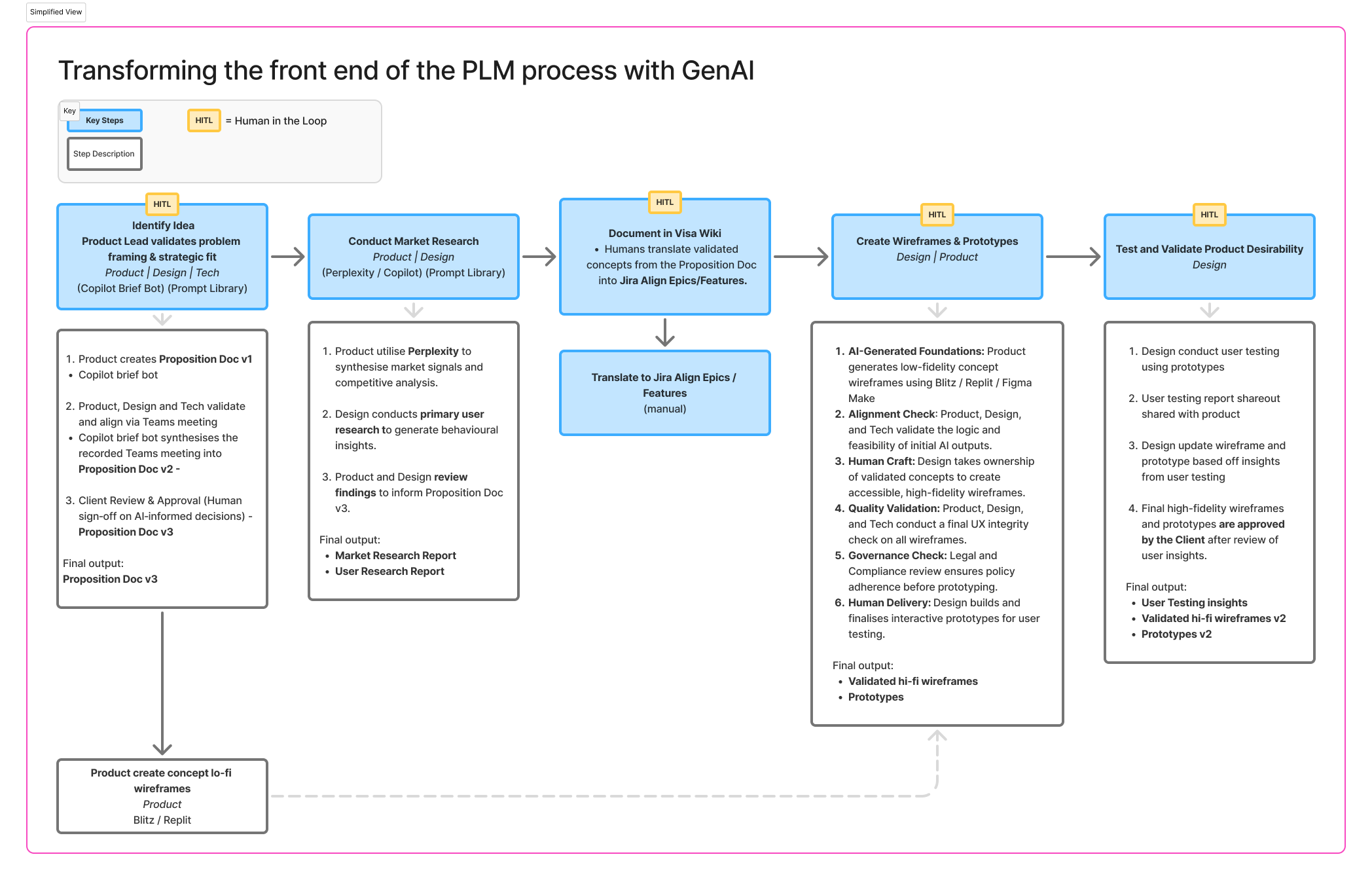
AI x Human PLM Framework
Critical Trade-offs
Traceability over Speed: To prevent "hallucinated" requirements from entering production, I intentionally designed friction back into the process. We mandated human sign-offs for all AI-generated documentation, prioritising safety over pure automation.
Consistency over Flexibility: I introduced standardised templates and prompts. While this limited free-form experimentation, it was necessary to ensure that work remained comparable and auditable across global teams.
Impact & Business Outcome
Enterprise Blueprint:
Established the first official model for responsible AI usage across the product lifecycle.
40% Efficiency Gain
Significantly reduced "blank page friction" during the early research and framing stages.
Defined Ownership
Created a transparent system where everyone knows exactly where AI assistance ends and human responsibility begins.
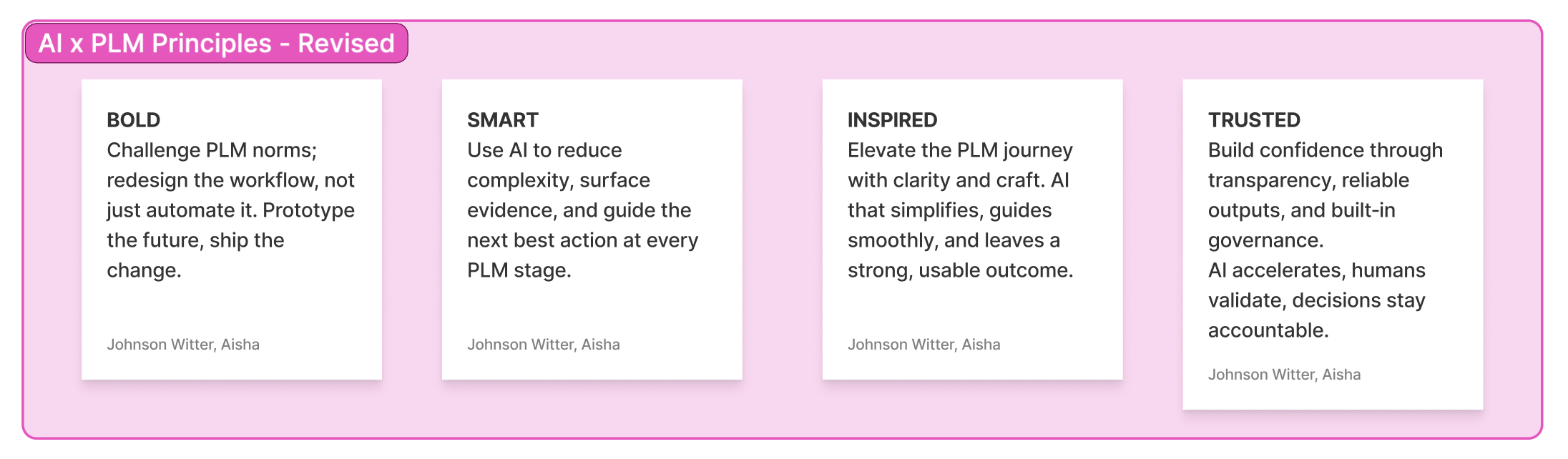
AI x Human PLM Framework Grounded in Visa Design Principles